Add up the watts of everything you want to run, multiply by the hours of backup you need, then divide by 0.8 to keep the battery within a healthy 80% depth of discharge. Allow about 10% more for inverter losses. For example, 1,000 W for 4 hours is 4 kWh, so you need about 5 kWh of LiFePO4 storage, or about 5.5 kWh once you allow for the inverter.
Step 1: list what must keep running
Write down every appliance you need during a power cut and its power in watts. The rating is on the label or in the manual.
| Example: small shop | Watts |
|---|---|
| 6 LED lights × 15 W | 90 W |
| 3 ceiling fans × 70 W | 210 W |
| Computer, printer and billing machine | 300 W |
| Wi-Fi router and CCTV | 60 W |
| Total | 660 W |
Step 2: multiply by backup hours
If power cuts last up to 4 hours: 660 W × 4 h = 2,640 Wh, or 2.64 kWh of energy you will actually use.
Step 3: allow for depth of discharge
Running any battery to completely empty every time shortens its life. We size LiFePO4 for 80% depth of discharge, so divide by 0.8: 2.64 ÷ 0.8 = 3.3 kWh.
Step 4: allow for the inverter
An inverter loses some energy turning battery DC into AC. Add about 10%: 3.3 × 1.1 ≈ 3.6 kWh. That is the battery size to ask for.
Two more things to check
- Peak load. Motors, pumps and compressors draw a surge when they start. The inverter must handle the surge, not only the running load.
- Solar charging. If the battery is charged by solar, the panels must refill it on a normal day. Your solar installer can match the panel size to the battery.
Which format suits you
- Wall-mount LiFePO4 for homes, shops and clinics, sized to your load.
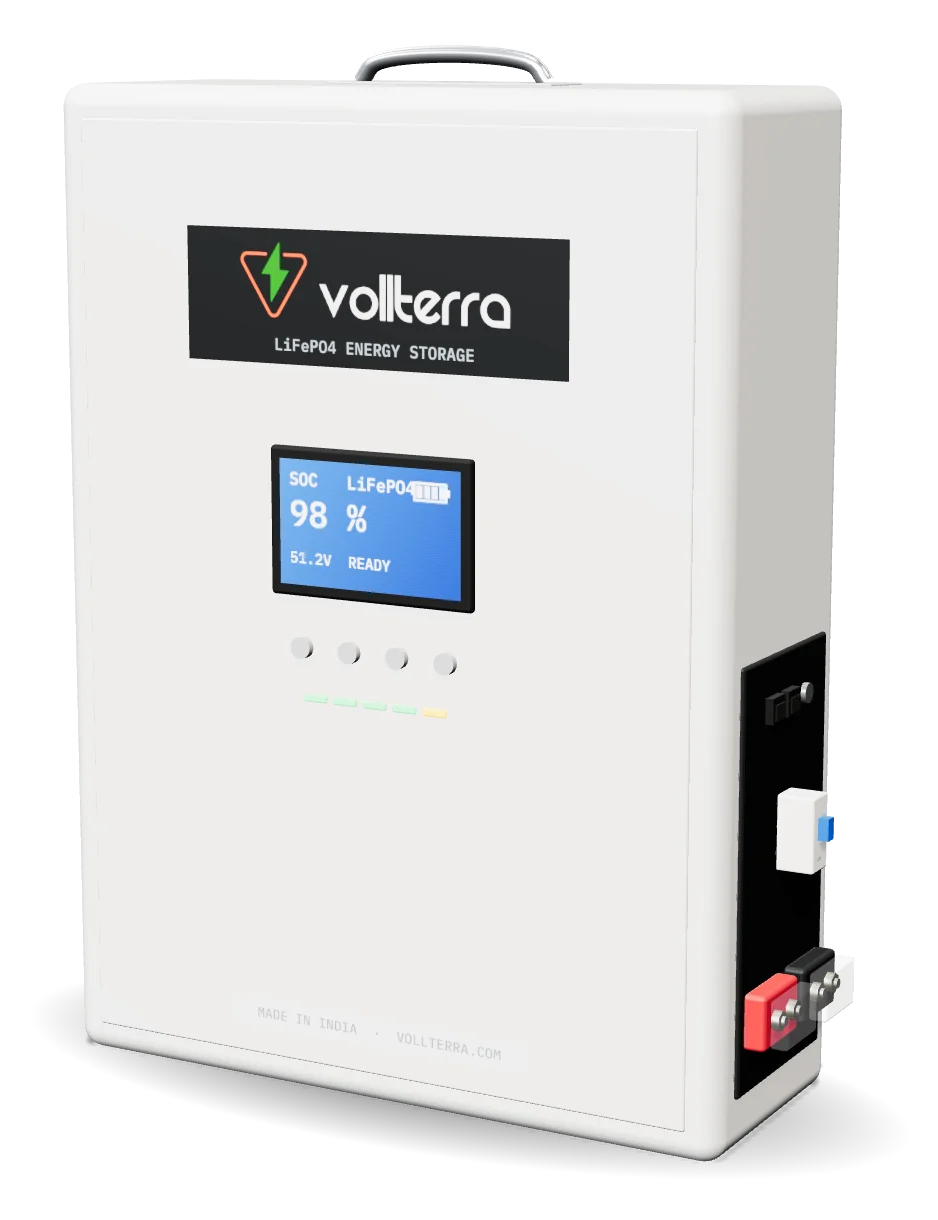
- All-in-one ESS: a 2.5 kVA inverter with a 2.56 kWh battery built in. At 80% depth of discharge that is about 2 kWh, or roughly 500 W for 4 hours.
- Rack-mount modules for larger sites. Add modules for more kWh.
Try the quick sizing tool on our storage page, then send us the result for an exact quote.
Not sure which pack fits?
Send us your vehicle model or what you need to power. We reply with a fit check and today's price.
Questions people also ask
How many kWh battery do I need for a 1 kW load for 4 hours?
About 5 kWh of LiFePO4 storage at 80% depth of discharge, or about 5.5 kWh once you allow for inverter losses.
Is lithium better than lead-acid for inverter backup?
For daily use, usually yes. LiFePO4 can be used more deeply, charges faster, needs no water and lasts many more cycles. Lead-acid costs less upfront.
How long will a 2.56 kWh battery run my home?
About 2 kWh is usable at 80% depth of discharge. That runs a 500 W load for about 4 hours, or a 250 W load for about 8 hours, before inverter losses.